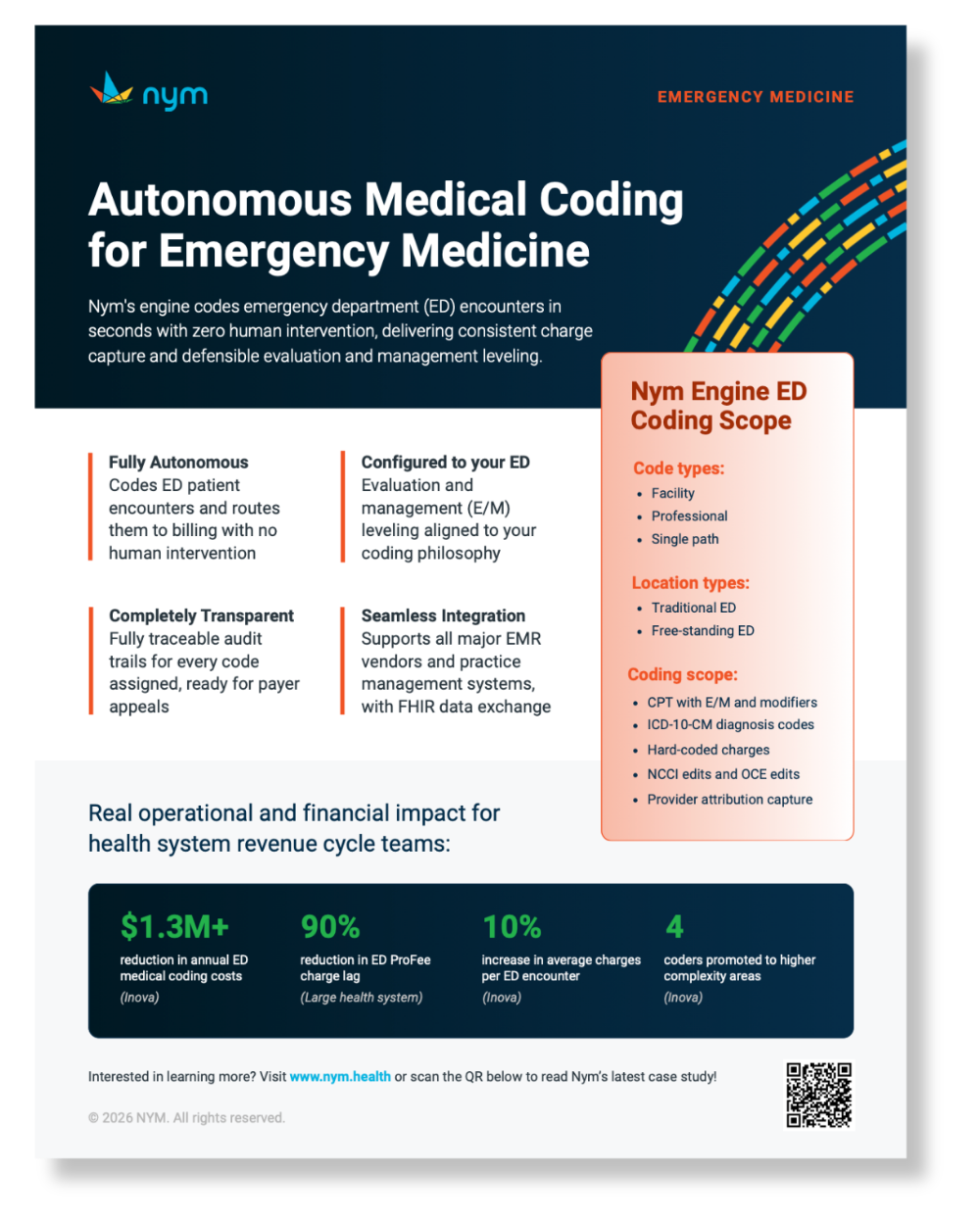
Nym's engine codes ED encounters in seconds with zero human intervention. Here's the impact that this can have on your medical coding and revenue cycle teams.
Nym typically codes ~60-70% of ED encounters and sends them to billing with no human intervention. Any increase in patient volume is handled with compute power, not headcount.

Nym's engine codes patient encounters on a nightly basis, eliminating the risk that weekends, holidays included, and PTO can cause when ED coding teams are short-staffed.
Evaluation and management (E/M) leveling is configured to your coding philosophy and applied consistently, with a fully traceable audit trail behind every code assigned.
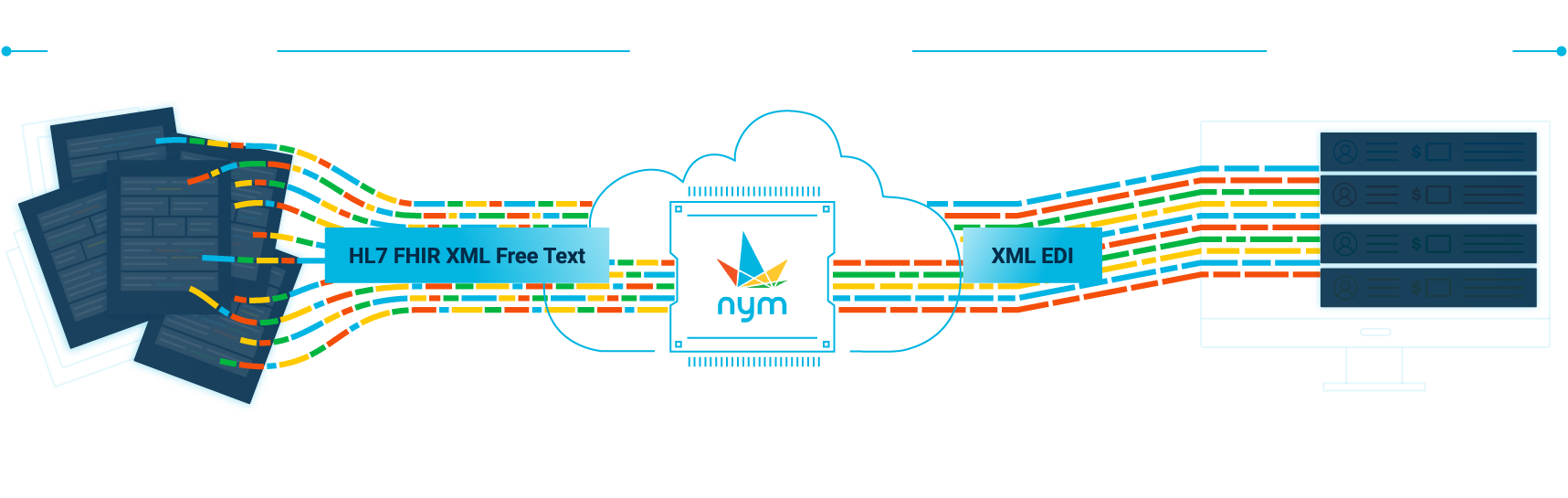
Full ED coding coverage, configured to your organization's coding philosophy and guidelines, and updated as soon as new guidelines are released.

*encounters that the engine is unable to code with high confidence are routed to human coders
Nym's engine is driving real financial and operational impact for emergency departments across the country.
Reduction in annual ED medical coding costs
Inova

Increase in average charges per ED encounter
Inova
Reduction in emergency medicine ProFee charge lag
Large 1,000+ bed health system

Monthly labor savings from eliminated ED overtime
Large 1,000+ bed health system
Autonomous medical coding for the emergency department is technology that reads a completed ED chart, assigns the diagnosis and procedure codes, and sends the coded encounter directly to billing with zero human intervention. Nym's autonomous medical coding engine codes ED encounters in seconds and typically codes 60-70% of ED charts this way. Encounters the engine cannot code confidently are routed to the health system's coders.
Autonomous medical coding assigns codes and sends patient encounters straight to billing with zero human intervention. AI-assisted coding may code only portions of an encounter or require a human coder to review the output. Computer-assisted coding (CAC) suggests codes that a human coder validates on every encounter. Nym's engine is autonomous: coded ED encounters go directly to billing, and each one carries an audit trail showing the documentation behind every code.
Nym's engine assigns ED facility E/M levels using each health system's own facility leveling guidelines, configured at implementation and applied consistently across every encounter the engine codes. Nym's standard leveling logic is based on ACEP's facility level coding guidelines, which define levels by possible interventions. Because CMS has never issued a national standard for ED facility E/M assignment, leveling criteria vary by organization, and the engine is configured to match yours rather than applying its own.
Nym's engine typically codes 60-70% of ED encounters autonomously and routes them straight to billing with zero human intervention. Encounters with missing documentation, conflicting information, or clinical ambiguity are routed to the health system's coding team for manual review. Coders spend their time on the charts that require clinical judgment instead of the routine volume.
Yes. Nym's engine produces a fully traceable audit trail for every code it assigns, showing the supporting documentation in the chart and the specific coding guideline applied. Unlike black box AI approaches, Nym's Clinical Language Understanding (CLU) technology makes each coding decision reviewable. When a payer downcodes or denies an ED claim, your team can respond with the documented rationale behind the original code.
Results vary by health system, but health systems using Nym's engine for ED coding are experiencing lower coding costs, faster time-to-bill, and more complete charge capture. At Inova, one year after deploying Nym's engine across five hospital EDs, annual ED coding costs fell by more than $1.3M, weekly revenue sitting in ED DNFB dropped 50%, and average charges per ED encounter rose 10%. Inova also eliminated mandatory overtime for its ED coders.
Nym's engine supports facility coding, professional coding, and single-path coding for the emergency department, in both traditional and free-standing EDs. Coverage includes CPT with E/M levels and modifiers, ICD-10-CM diagnosis codes, hard-coded charges, NCCI and OCE edits, and provider attribution capture, with E/M leveling configured to each organization's coding philosophy.
Autonomous medical coding does not eliminate the need for ED coders, and it does not decide how a health system staffs. Nym's engine typically codes 60-70% of ED encounters, so the remaining charts, along with auditing, compliance, and revenue integrity work, still require experienced coders. What each organization does with the recovered capacity varies. Some redeploy coders into higher complexity work: at Inova, four ED coders moved into higher complexity areas after deployment, and at Genesis HealthCare System, coders are being trained to move into departments such as inpatient. Others reduce their reliance on contract and outsourced coding, or absorb retirements and attrition without backfilling.